
Drone delivery is rapidly emerging as one of the most promising innovations in the logistics industry. As customer expectations shift toward faster, more efficient deliveries, traditional last-mile logistics models are being challenged. Drone delivery offers a new approach, one that combines speed, automation, and precision to reshape how goods are transported.
What once felt experimental is now gaining real traction across global supply chains, positioning drone delivery as a key component of the future of logistics.
What Is Drone Delivery?
Drone delivery refers to the use of unmanned aerial vehicles (UAVs) to transport packages from fulfillment centers to end customers. These drones operate using GPS navigation, sensors, and automated flight systems to deliver shipments without relying on conventional road infrastructure.
Unlike traditional delivery vehicles, drones take direct aerial routes, allowing them to bypass traffic congestion and geographical barriers. This makes drone delivery particularly effective for urgent shipments, lightweight packages, and deliveries to hard-to-reach locations.
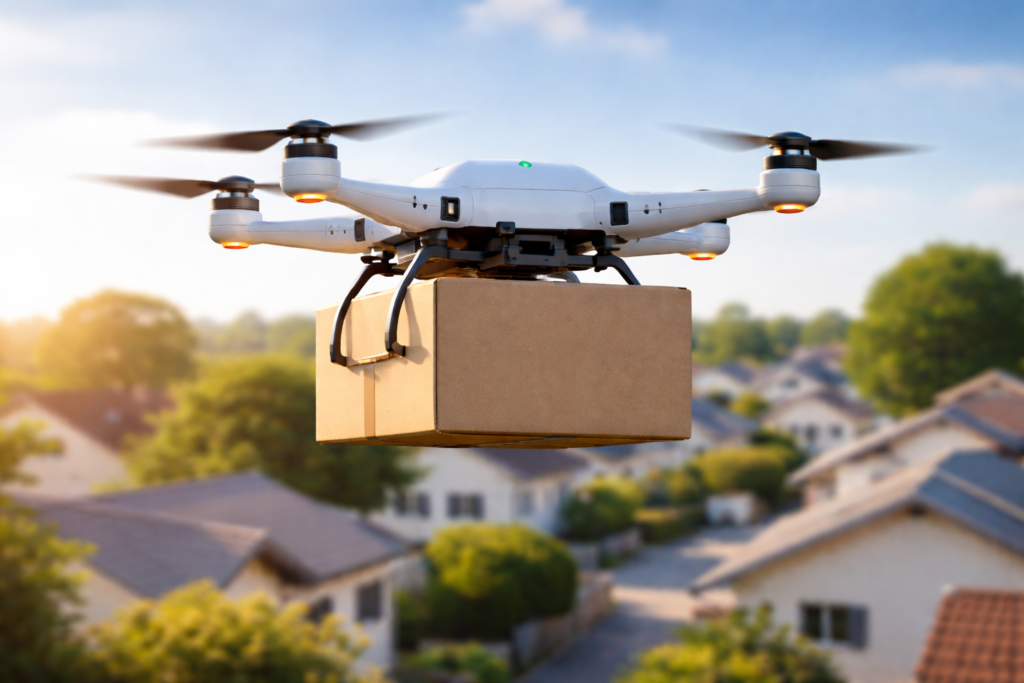
Source: ChatGPT
How Drone Delivery Works in Logistics?
Drone delivery enables packages to be transported through unmanned aerial vehicles for faster last-mile fulfilment. Once an order qualifies for drone delivery, it is prepared at a nearby fulfilment centre and assigned an automated flight route using GPS and navigation software. The drone then flies directly to the delivery location, avoiding road traffic and delays, and safely drops the package at a designated point. After completion, it returns to base for recharging and the next delivery cycle.
Brands like Amazon and Uber are already using drone delivery in controlled environments to reduce delivery times for lightweight and time-sensitive orders.
Why Drone Delivery Matters for the Logistics Industry
Faster Delivery Timelines
One of the biggest advantages of drone delivery is speed. By avoiding road traffic and following direct routes, drones can complete deliveries in minutes rather than hours. This is particularly valuable for same-day and on-demand delivery models.
Improved Cost Efficiency
While drone infrastructure requires initial investment, it has the potential to lower long-term delivery costs by reducing fuel usage, labor dependency, and vehicle maintenance. Over time, this can lead to more sustainable logistics operations.
Environmental Sustainability
Drone delivery systems are typically electric-powered, resulting in lower carbon emissions compared to traditional delivery vehicles. This supports environmentally responsible logistics and helps businesses move toward greener supply chains.
Expanded Delivery Reach
Drones enable deliveries to remote or underserved areas where conventional logistics face limitations. This opens new opportunities for businesses to serve customers beyond standard delivery zones.
Current Use Cases of Drone Delivery
Drone delivery is already being explored across several industries:
- Healthcare logistics for delivering medical supplies and emergency equipment
- E-commerce for ultra-fast delivery of lightweight consumer goods
- Food and grocery delivery in urban and semi-urban areas
- Logistics support in rural and geographically challenging regions
These applications demonstrate how it can complement existing logistics networks rather than replace them entirely.
Challenges in Drone Delivery Adoption
Despite its potential, it still faces challenges that need to be addressed before large-scale adoption becomes mainstream.
Regulatory Limitations
Airspace regulations vary across regions and require strict compliance to ensure safety. Regulatory frameworks are still evolving to accommodate commercial drone operations.
Payload and Distance Constraints
Current drones can carry only lightweight packages over short distances. Advancements in battery technology and drone design are needed to expand these capabilities.
Safety and Privacy Concerns
Ensuring secure package delivery and addressing privacy concerns related to aerial operations remain important considerations for businesses and regulators.
Weather and Technical Dependencies
Drone delivery performance can be affected by weather conditions such as wind and rain, requiring robust systems to ensure reliability.

The Future of Drone Delivery in Logistics
The future of drone delivery is closely tied to advancements in automation, artificial intelligence, and smart logistics infrastructure. As technology evolves and regulations mature, it is expected to become a practical extension of last-mile logistics rather than a niche innovation.
For logistics platforms and e-commerce brands, understanding it today helps prepare for tomorrow’s delivery expectations, where speed, efficiency, and sustainability define competitive advantage.
Read more:
Trusted & Best Shipping Company for Ecommerce in India (2025)
Air vs Surface Shipping: Which Mode is Best for Your D2C Business in 2025
Top 5 Same Day Intracity Delivery in India
List of Pin codes in India | Ecommerce Shipping (2025)
How Fship Works: Guide to Seamless E-commerce Shipping Process