
Getting orders is exciting for any ecommerce seller. But high sales do not always mean high profits. A product may sell well and still leave you with very little money after product costs, advertising, shipping and returns are taken into account.
This is why it is important to know how much you actually earn from every order. Without tracking these costs, it can be difficult to decide the right selling price, plan your advertising budget or understand whether your business is making money.
An Ecommerce Profit Calculator makes this process easier by bringing your costs and order details together. Instead of working through multiple spreadsheets, you can enter your business figures and estimate how much you could earn.
What Is Ecommerce Profit?
Ecommerce profit is the money left after deducting the costs of running your online business from the revenue you earn through sales.
These costs can include product sourcing, advertising, shipping, packaging, return-to-origin (RTO) expenses and other business expenses.
For example, suppose you sell a product for ₹1,000. The product costs you ₹350, advertising costs ₹150, shipping costs ₹70, and packaging costs ₹30.
Your calculation would look like this:
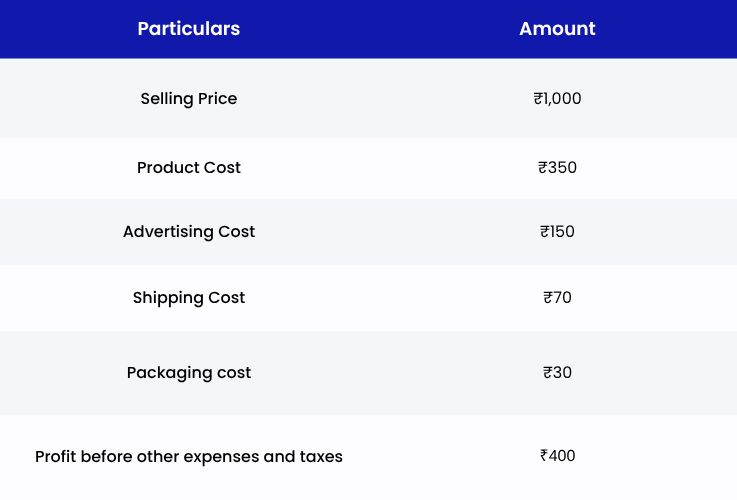
Your profit in this example is ₹400 per delivered order, before any other expenses or applicable taxes.
The formula is simple:
Ecommerce Profit = Total Revenue − Total Business Costs
However, it is important to understand the difference between revenue, profit and profit margin.
- Revenue: The money earned from sales before deducting costs.
- Profit: The amount left after deducting the relevant costs from revenue.
- Profit margin: The percentage of revenue that remains as profit.
In the example above, the profit margin is 40% because ₹400 is 40% of the ₹1,000 selling price.
For an ecommerce business, calculating profit also means looking beyond successful deliveries. Cancelled orders, failed deliveries and RTO expenses can affect the final amount you earn.
Why Is It Necessary to Calculate Ecommerce Profit?
Many sellers focus on the number of orders they receive every day. While order growth is important, it does not always tell the full story.
Knowing your profit helps you understand whether those orders are actually contributing to your business.
Set the right selling price
If you set your product price without considering advertising, shipping and other expenses, you may end up selling at a very low margin.
For example, a product that costs ₹300 may look profitable when sold for ₹500. But after ₹100 in advertising, ₹60 in shipping and ₹20 in packaging, only ₹20 remains before other expenses and taxes.
Calculating profit before setting the price helps you avoid such situations.
Understand your advertising spend
Advertising can bring more customers to your store, but it also increases your costs.
Suppose you spend ₹5,000 on ads and receive 50 orders. Your advertising cost per order is ₹100.
If you receive the same number of orders but your advertising spend increases to ₹7,500, your cost per order rises to ₹150. Unless your selling price or other costs change, your profit will decrease.
Tracking this number helps you understand whether your advertising spend is working for your business.
Account for RTO and failed deliveries
Not every confirmed order reaches the customer. Some orders may be returned to origin because the customer is unavailable, refuses delivery or cannot be reached.
These orders can lead to additional shipping and handling expenses. Depending on your product and return process, you may also have to deal with repackaging, damaged goods or inventory that cannot be sold again.
Including these costs in your calculations gives you a more realistic view of your earnings.
Make better business decisions
Profit calculations can help you decide which products to promote, whether a discount is affordable and how much you can spend on acquiring customers.
They also help you compare different selling prices and cost scenarios before making changes.
When you know your numbers, you can make decisions based on your actual costs instead of relying only on sales figures.
How to Calculate Ecommerce Profit Per Order?
To calculate ecommerce profit, you need to know your selling price and the costs involved in getting the product to the customer.
Here are the main figures to consider.
Step 1: Calculate your revenue
Revenue is the amount you earn from selling your products.
For example, if you sell 50 units at ₹800 each, your sales revenue is:
50 × ₹800 = ₹40,000
This is your revenue, not your profit.
Step 2: Add your product and sourcing costs
Include the amount you spend to purchase or manufacture your products.
If each unit costs ₹300 and you sell 50 units, your product cost for those units is ₹15,000.
Step 3: Include advertising costs
Divide your advertising spend by the number of orders you are using for the calculation.
For example, if you spend ₹6,000 on advertising and receive 60 orders:
₹6,000 ÷ 60 = ₹100 per order
You can use this figure to understand how much advertising adds to the cost of each order.
Step 4: Include shipping and other expenses
Shipping charges, packaging, payment fees and other operating expenses can all affect your profit.
You should also account for RTO-related costs. The amount will depend on your courier charges, return process and the number of failed deliveries.
Step 5: Subtract your costs from revenue
Once you have collected the relevant figures, use this formula:
Profit = Revenue − Total Costs
To calculate profit margin:
Profit Margin = (Profit ÷ Revenue) × 100
For example, if your revenue is ₹40,000 and your total costs are ₹30,000, your profit is ₹10,000.
Your profit margin is:
(₹10,000 ÷ ₹40,000) × 100 = 25%
This means you retain ₹25 as profit for every ₹100 in revenue, before any expenses that have not yet been included.
For a business with COD orders, failed deliveries or frequent returns, it is important to include the costs associated with those orders as well. Otherwise, your calculation may show a better result than your actual business performance.

Common Mistakes Sellers Make While Calculating Ecommerce Profit
Even when sellers track their sales regularly, some costs can be easy to miss. These mistakes can make a business look more profitable than it really is.
Counting revenue as profit
Receiving ₹1 lakh in sales does not mean you have earned ₹1 lakh in profit. Product costs, advertising, shipping and other expenses still need to be deducted.
Always look at what remains after costs, not just the total sales amount.
Ignoring advertising expenses
Advertising is often one of the biggest costs for online sellers. If you calculate profit without including ad spend, you may overestimate how much each order earns.
Keep track of your advertising spend and the number of orders it brings in.
Forgetting RTO costs
A failed delivery can involve shipping charges and return-related expenses. If these costs are not included, your profit calculation may miss an important part of your fulfilment expenses.
This is especially important for sellers who receive a large share of COD orders.
Using the same calculation for every order
Different products can have different sourcing costs, selling prices, shipping charges and return rates.
A calculation that works for one product may not work for another. Review your numbers at the product level whenever possible.
Not accounting for all business expenses
Packaging, payment gateway charges, marketplace fees, discounts and other expenses can reduce the amount you keep from each sale.
You do not need to complicate every calculation, but you should know which costs have been included and which still need to be accounted for.
Looking only at delivered orders
Delivered orders are important, but they do not show the entire journey of your shipments.
If you ignore cancelled or returned orders, you may miss expenses that affect your overall profitability. Consider expected orders, confirmation rates, delivery rates and RTO costs when estimating profit across your business.
How Fship’s Ecommerce Profit Calculator Helps Sellers?
Calculating ecommerce profit manually can take time, especially when you need to account for different costs and order outcomes. Fship’s Ecommerce Profit Calculator helps you bring these details together and estimate your profit without having to work through every calculation yourself.
The calculator lets you enter your product and sourcing cost, advertising cost, selling price, RTO cost, expected order units, confirmation rate, expected delivery rate and miscellaneous costs.
Once you enter your figures and select Calculate, the tool provides an estimate of your net profit and net profit per order.
Here is how sellers can use it.
Enter your costs and selling price
Start by entering the amount you spend on the product, advertising, RTO and other expenses. Then enter your selling price.
For example, imagine you sell a skincare product online. Your product costs ₹100, your advertising cost is ₹40, your selling price is ₹500, your RTO cost is ₹50, and your miscellaneous cost is ₹10.
These are sample figures for illustration. Your actual numbers will depend on your product and business.
Add your expected order details
The number of orders you receive is not always the number of orders that reach customers. Confirmation and delivery rates help you estimate how many orders may successfully reach their destination.
Suppose you expect 100 orders, with an 80% confirmation rate and an 80% delivery rate.
Your estimated order journey would look like this:
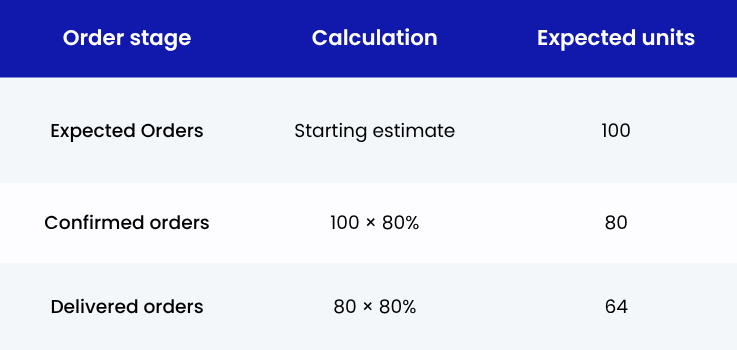
In this example, 100 expected orders could result in 64 deliveries, assuming the delivery rate is applied to confirmed orders.
This is why it is useful to consider confirmation and delivery rates when planning your business costs. The final result will depend on the actual order figures and how the costs apply to successful and failed orders.
Understand your estimated profit
After entering the sample costs and order details, the calculator estimates your net profit by comparing total earnings with total expenses. It also shows net profit per order by dividing net profit by expected orders.
This helps you look beyond the selling price and understand how your costs and order outcomes affect the amount you could earn.
For instance, if your selling price is ₹500 and 64 orders are delivered, the revenue from those deliveries would be:
64 × ₹500 = ₹32,000
Remember: ₹32,000 is revenue, not profit. Product costs, advertising, RTO expenses and other relevant costs still need to be accounted for. The calculator helps you bring these figures together to estimate the result.
Compare different selling prices
You can also use the calculator to test different selling prices and cost scenarios.
For example, you might want to check what happens if you increase your selling price from ₹500 to ₹550, or if your advertising cost per order rises.
By comparing the estimates, you can see how a change in one input affects your expected profitability. This can help you make more informed pricing decisions before changing your actual prices.
Know where your money is going
Whether you run a small online store, a growing D2C brand or a larger ecommerce business, tracking your costs helps you understand what affects your earnings.
Fship’s calculator brings the main inputs together so you can estimate profit without relying on manual calculations every time.
Conclusion
Running an ecommerce business is not just about getting more orders. It is also about understanding how much you earn after covering the costs involved in making and delivering those orders.
Product costs, advertising, shipping, RTO and other expenses can all affect your final profit. If you overlook them, you may end up making decisions based on sales figures that do not reflect your actual earnings.
An Ecommerce Profit Calculator makes it easier to bring these numbers together and estimate your profit per order. It can also help you compare selling prices, review your expenses and plan your next steps with more confidence.
Before you focus only on increasing sales, take the time to understand your numbers. Try Fship’s Ecommerce Profit Calculator and get a clearer picture of how your costs affect your ecommerce profit.

Frequently Asked Questions:
1. How do you calculate profit in an ecommerce business?
To calculate ecommerce profit, subtract all relevant business costs from your total revenue. These costs may include product cost, advertising, shipping, packaging, RTO expenses and other operating expenses. To calculate profit margin, divide your profit by revenue and multiply by 100.
2. How does an ecommerce profit calculator help sellers?
An ecommerce profit calculator helps sellers estimate their earnings by bringing costs and order details together. It can help them account for product costs, advertising, shipping, RTO and other expenses to understand how these costs affect their profit per order.
3. What costs should be included when calculating ecommerce profit?
Sellers should consider product or manufacturing costs, advertising spend, shipping charges, packaging, payment fees, marketplace fees where applicable, RTO expenses and other operating costs. Including relevant expenses gives a more realistic estimate of profit than looking at sales revenue alone.