Running an ecommerce business involves more than selling products and receiving orders. Every order also needs to reach the customer safely, on time and at a reasonable shipping cost.
Choosing the right courier partner can directly affect delivery performance, customer experience, return-to-origin (RTO) rates and business profitability. A courier service that works well for one business may not deliver the same results for another.
For example, a fashion brand shipping 500 COD orders every day may have different logistics requirements from an electronics seller shipping 100 prepaid orders every week.
So, how do you choose the right courier partner for your ecommerce business?
The right approach is to compare courier partners based on delivery performance, PIN code coverage, shipping rates, COD handling, tracking capabilities, return management and technology integrations. You should also evaluate their performance using your own shipment data rather than relying only on advertised delivery promises.
Why Does Choosing the Right Courier Partner Matter for Ecommerce Businesses?
A courier partner plays a direct role in the post-purchase experience. Once a customer places an order, the delivery process becomes one of the most visible interactions between the customer and the brand.
A poor delivery experience can lead to customer complaints, cancelled orders, failed deliveries and additional logistics expenses.
According to the 2025 DHL E-Commerce Trends Report, 96% of surveyed retailers consider their logistics offering important to securing sales. The report also found that 43% of retailers work with three or more logistics providers for deliveries and returns.
This highlights why ecommerce businesses should evaluate their logistics strategy carefully instead of depending entirely on one courier company.
For Indian ecommerce sellers, the challenge is even more specific. Businesses often need to deliver across metro cities, Tier 2 cities, Tier 3 cities and remote PIN codes while managing COD orders and reverse shipments.
A suitable courier partner can help businesses:
- Deliver orders within the promised timeframe.
- Reach customers across different locations.
- Manage COD collections and remittances.
- Reduce avoidable delivery failures.
- Provide customers with shipment tracking.
- Handle reverse pickups and customer returns.
- Control shipping expenses.
Choosing a courier partner should therefore be treated as a business decision, not simply a search for the lowest shipping rate.
10 Factors to Consider When Choosing the Right Courier Partner
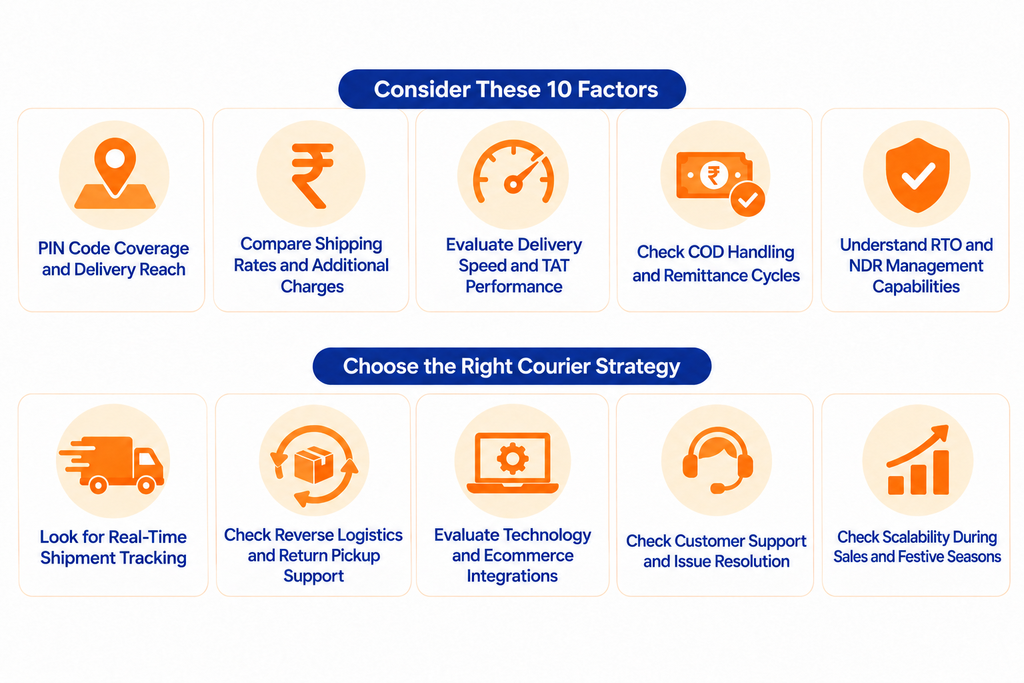
Before selecting a courier service for your ecommerce business, evaluate the following factors.
1. PIN Code Coverage and Delivery Reach
PIN code coverage should be one of the first things you check when selecting a courier partner.
A courier company may provide excellent delivery services in metropolitan cities but have limited serviceability in smaller towns or remote locations.
This can become a problem when your customer base expands beyond major cities.
According to the Redseer Research report India B2C E-Commerce Logistics Market (August 2024), approximately 56% of India’s B2C ecommerce GMV originated from Tier 2 and smaller cities in FY 2024.
This makes delivery reach an important consideration for businesses selling across India.
Before choosing a courier partner, check:
- Whether the courier services your major customer locations.
- Whether it supports delivery to Tier 2 and Tier 3 cities.
- Whether remote and out-of-delivery-area (ODA) locations are covered.
- Whether reverse pickups are available in your major service areas.
- Whether serviceability changes for different shipment weights.
Practical tip: Prepare a list of your top 50 or 100 destination PIN codes based on historical orders. Compare the serviceability of different courier partners against this list instead of relying only on their overall coverage numbers.
2. Compare Shipping Rates and Additional Charges
Shipping costs directly affect the profit earned on every ecommerce order.
However, selecting a courier partner based only on the lowest advertised rate can be a costly mistake.
Your actual shipping expense may include several components:
- Forward shipping charges.
- Reverse shipping charges.
- Additional weight charges.
- Remote-area or ODA charges.
- COD handling charges.
- Fuel or other applicable surcharges.
- Weight discrepancy charges.
For example, consider two courier partners:
| Parameters | Courier A | Courier B |
| Forward Shipping | ₹45 | ₹38 |
| Additional Charges | ₹5 | ₹12 |
| Total Cost | ₹50 | ₹50 |
Although Courier B advertises a lower base rate, the final shipping expense is the same.
This is why ecommerce sellers should compare the complete shipping cost rather than the starting rate.
Practical tip: Calculate the average shipping cost per delivered order. Include RTO and reverse shipping expenses to understand the actual logistics cost of fulfilling an order.
3. Evaluate Delivery Speed and TAT Performance
Delivery speed affects customer satisfaction and the likelihood of repeat purchases.
A courier partner should be able to deliver orders within a reasonable timeframe across the locations where your customers are based.
However, advertised delivery timelines and actual delivery performance can differ.
Check these metrics before finalising a courier partner:
- Average delivery time.
- First-attempt delivery success rate.
- On-time delivery percentage.
- Pickup performance.
- Delayed shipment percentage.
- Delivery performance by PIN code.
For example, a courier promising delivery within three days may consistently take five days in certain locations. This can affect your customer experience even if its overall performance appears satisfactory.
Instead of evaluating delivery speed using general claims, analyse actual shipment data over a representative period.
Practical tip: Compare delivery performance separately for metro, Tier 2, Tier 3 and remote locations. This will help you identify which courier works best for each region.
4. Check COD Handling and Remittance Cycles
Cash on Delivery (COD) remains an important payment option for Indian ecommerce businesses.
According to the Redseer Research report on India’s B2C ecommerce logistics market, COD contributed over 40% of B2C ecommerce GMV in FY 2024 and accounted for approximately 27% of total shipments.
This makes COD collection and remittance an important factor when choosing a courier partner.
A courier partner should provide:
- Reliable COD collection.
- Clear remittance schedules.
- Shipment-wise COD reconciliation.
- Transparent payment records.
- Support for resolving payment discrepancies.
Delayed COD remittances can affect working capital, particularly for businesses that depend heavily on cash collections to manage inventory and operating expenses.
Practical tip: Ask the courier about its COD remittance cycle before signing up. Also check whether COD payments can be tracked and reconciled against individual orders.
5. Understand RTO and NDR Management Capabilities
Return to Origin (RTO) occurs when a shipment cannot be delivered to the customer and is returned to the seller.
Non-Delivery Reports (NDRs) are generated when delivery attempts fail or a delivery exception occurs.
Common reasons include:
- Customer unavailable.
- Incorrect or incomplete address.
- Customer refusing the order.
- Customer requesting a different delivery date.
- Customer not responding to delivery calls.
A courier partner should have a clear process for reporting failed deliveries and supporting further delivery attempts.
Look for features such as:
- Timely NDR notifications.
- Customer communication.
- Reattempt scheduling.
- Address correction support.
- NDR response management.
- Shipment-level RTO reporting.
An effective NDR management process can help sellers address genuine delivery issues before a shipment becomes an RTO.
Practical tip: Do not evaluate a courier only by its delivery percentage. Compare its RTO rate, NDR resolution rate and successful reattempt rate as well.
6. Look for Real-Time Shipment Tracking
Shipment tracking gives businesses and customers visibility into the delivery process.
Without proper tracking updates, customers may have to contact customer support to find out where their orders are.
A good courier partner should provide:
- Order dispatch updates.
- Pickup confirmation.
- In-transit tracking.
- Out-for-delivery notifications.
- Delivery confirmation.
- Exception and delay updates.
A branded tracking page can also improve the post-purchase experience by allowing customers to check their shipment status through a page that reflects the seller’s brand identity.
For ecommerce businesses processing hundreds or thousands of orders, automated tracking updates reduce the need for manual follow-ups.
7. Check Reverse Logistics and Return Pickup Support
Returns are part of ecommerce operations, particularly in categories such as fashion, footwear, electronics and beauty.
Choosing a courier partner that supports reverse logistics can make it easier to manage customer returns.
Before selecting a courier, check:
- Availability of reverse pickups.
- PIN code coverage for return shipments.
- Reverse shipping charges.
- Return pickup timelines.
- Shipment tracking during reverse transit.
- Handling of failed return pickups.
Reverse logistics should be evaluated separately from forward delivery because a courier that performs well for outbound shipments may not provide the same performance for returns.
8. Evaluate Technology and Ecommerce Integrations
Technology integration becomes increasingly important as your order volume grows.
If your courier partner does not integrate properly with your ecommerce platform, your team may have to manage orders, shipping labels and tracking information manually.
Look for integrations with platforms and systems such as:
- Shopify.
- WooCommerce.
- Magento.
- Unicommerce.
- Order management systems.
- Custom ecommerce platforms through APIs.
Your shipping platform should support automatic order syncing, shipping label generation, AWB generation and tracking updates.
Shipping automation reduces repetitive work and makes it easier to manage a growing number of shipments.
9. Check Customer Support and Issue Resolution
Shipping issues are unavoidable. Packages may get delayed, pickups may be missed and shipments may face delivery exceptions.
What matters is how quickly these issues are resolved.
Before selecting a courier partner, understand its customer support process.
Check whether it provides:
- Dedicated account management.
- Shipment escalation support.
- Weight dispute resolution.
- Delivery issue assistance.
- COD reconciliation support.
- Clear communication channels.
For a growing ecommerce business, having access to responsive support can save considerable time during operational issues.
10. Check Scalability During Sales and Festive Seasons
Your shipping requirements may change significantly during festive sales, promotional campaigns and seasonal demand.
A courier partner that handles 100 shipments per day may struggle when your business starts processing 1,000 shipments per day.
Before selecting a partner, understand its ability to handle:
- Sudden increases in shipment volumes.
- Bulk order processing.
- Faster pickup scheduling.
- Increased reverse shipment volumes.
- Peak-season delivery requirements.
Choose a shipping solution that can support your current order volume and your expected growth.
Single Courier Partner vs Multiple Courier Partners: Which Is Better?
Many ecommerce sellers start by working with one courier company. However, depending entirely on a single courier can create limitations when delivery performance varies across locations.
Using multiple courier partners gives businesses more flexibility.
The DHL 2025 E-Commerce Trends Report found that 43% of surveyed retailers work with three or more logistics providers for delivery and returns.
Here is how the two approaches compare:
| Parameter | Single Courier Partner | Multiple Courier Partners |
| Delivery coverage | Depends on one network | Access to multiple networks |
| Delivery performance | Limited to one provider’s performance | Ability to select based on performance |
| Shipping rates | One pricing structure | More pricing options |
| Operational flexibility | Relatively limited | Greater flexibility |
| Risk management | Higher dependence on one provider | Less dependence on one provider |
| Management | Simpler initially | Requires centralised management |
Which approach should you choose?
A single courier partner may work well for a small business with limited shipping locations and consistent order volumes.
Multiple courier partners are generally more suitable for businesses shipping across different regions, handling larger order volumes or experiencing inconsistent delivery performance.
The important thing is to manage multiple courier partners through a centralised system rather than handling each integration separately.
How to Compare Different Courier Partners Before Making a Decision
Once you have shortlisted a few courier companies, compare their performance using the same shipment data and evaluation criteria.
Here is a simple comparison framework:
| Evaluation Metric | What to Check |
| PIN code coverage | Serviceability across your customer locations |
| Shipping cost | Total cost per shipment |
| Pickup performance | Percentage of shipments picked up successfully |
| Delivery TAT | Average time taken to deliver orders |
| First-attempt delivery | Percentage delivered on the first attempt |
| RTO rate | Percentage of shipments returned to origin |
| COD remittance | Time taken to settle COD collections |
| NDR management | Ability to resolve failed delivery attempts |
| Reverse pickup | Coverage and cost of return shipments |
| Customer support | Response and issue resolution time |
You can use this framework to compare courier partners over a consistent reporting period.
For a more accurate comparison, analyse at least 30 days of shipment data and separate the results by destination PIN code, payment mode and shipment category.
Remember: The best courier partner is not necessarily the cheapest or fastest one. It is the partner that delivers the right balance of cost, serviceability and delivery performance for your business.
Why Is Fship a Strong Shipping Solution for Ecommerce Businesses?
Choosing the right courier partner becomes easier when you have access to multiple courier companies through one platform.
This is where Fship comes in.
Fship is an ecommerce shipping aggregator that helps businesses manage their shipping operations through a centralised platform. Instead of depending on a single courier company, sellers can access multiple courier partners and manage shipments from one dashboard.
Fship is designed to help ecommerce and D2C businesses simplify shipping operations, improve courier selection and manage post-shipping activities.
Here is what makes Fship a suitable option for ecommerce sellers.
1. Multiple Courier Partners Through One Platform
Fship integrates with multiple courier partners, including Delhivery, Blue Dart, DTDC, Ecom Express, Ekart, Shadowfax, XpressBees and Amazon Shipping.
This gives ecommerce sellers more flexibility when selecting a courier for different shipment requirements.
Instead of managing separate courier accounts and systems, businesses can manage their shipping operations through Fship.
2. AI-Based Courier Allocation
Choosing a courier manually for every shipment can become difficult as order volumes increase.
Fship offers an AI-based courier allocation feature that helps businesses select suitable courier options based on factors such as shipping cost, destination and delivery requirements.
This helps sellers make more informed courier allocation decisions instead of depending on a single courier for every shipment.
3. Centralised Order and Channel Integration
Fship supports integrations with ecommerce platforms such as Shopify, WooCommerce and Magento, along with Unicommerce and other supported systems.
Orders can be synced with the Fship platform, reducing manual data entry and helping businesses manage shipments from one place.
4. Custom Order Validation
Incorrect addresses, incomplete customer details and invalid orders can create avoidable delivery problems.
Fship’s Custom Order Validation feature helps businesses validate order information before shipment processing.
This gives sellers an opportunity to identify potential order issues before dispatch.
5. NDR Management and Customer Communication
Managing failed delivery attempts requires timely communication with customers.
Fship offers NDR management capabilities and automated workflows to help businesses handle delivery exceptions.
Its available solutions include WhatsApp communication and manual NDR calling on applicable plans.
These features can help sellers follow up on failed deliveries and improve their chances of completing deliveries successfully.
6. Branded Shipment Tracking
Fship provides branded tracking pages that allow ecommerce businesses to offer customers a tracking experience aligned with their brand identity.
Customers can check shipment progress without having to depend entirely on manual customer support updates.
7. Dedicated Account Management
Shipping issues often require coordination and timely resolution.
Fship offers dedicated account management on applicable plans, helping businesses get assistance with shipping operations and account-related requirements.
This can be particularly useful for businesses processing larger shipment volumes.
8. Shipping Plans for Different Business Sizes
Different ecommerce businesses have different shipping requirements.
Fship offers multiple plans designed around different shipment volumes, with features such as courier selection, branded tracking, bulk shipping, order validation, NDR workflows and account management depending on the selected plan.
Businesses can review the available plans and choose one that matches their shipping requirements.
Common Mistakes to Avoid When Selecting an Ecommerce Courier Partner
Even after comparing different courier companies, ecommerce businesses can make mistakes that affect their shipping performance.
Avoid these common mistakes:
1. Choosing only by price: A lower shipping rate does not always mean lower overall logistics expenses. Consider RTO charges, reverse shipping and additional weight costs.
2. Ignoring PIN code-level performance: A courier may perform well overall but have poor delivery performance in your highest-order locations.
3. Depending on a single courier: Relying entirely on one courier can limit flexibility when serviceability or delivery performance changes.
4. Ignoring COD remittance: Delayed COD settlements can affect cash flow and working capital.
5. Not monitoring RTO and NDR: Failed delivery attempts should be analysed to identify operational problems and opportunities for improvement.
6. Overlooking technology integration: Manual order processing becomes difficult as shipment volumes grow. Check integration and automation capabilities before selecting a partner.
7. Not reviewing courier performance: Shipping performance should be monitored regularly. A courier that works well today may not deliver the same results across every location or season.
Final Thoughts
Choosing the right courier partner is an important decision for every ecommerce business. The right shipping arrangement can help control logistics expenses, improve delivery performance and provide customers with a better post-purchase experience.
Before finalising a courier partner, compare its actual performance across your major delivery locations. Evaluate the complete shipping cost, COD handling, RTO management, tracking capabilities and ability to support future growth.
If your business ships across multiple locations and needs more flexibility in courier selection, a shipping aggregator like Fship can help bring multiple courier partners and shipping operations together on one platform.
The goal is simple: choose a shipping partner that supports your business operations today and can grow with your business tomorrow.
Frequently Asked Questions
1. How do I choose the best courier partner for my ecommerce business?
Choose a courier partner by comparing PIN code coverage, shipping rates, delivery timelines, COD handling, RTO performance, tracking capabilities, reverse logistics and customer support. Evaluate actual shipment performance instead of relying only on advertised service claims.
2. Which courier partner is best for ecommerce businesses in India?
The best courier partner depends on your shipment volume, delivery locations, product category, payment methods and budget. Businesses should compare multiple courier services and select the ones that perform best for their specific shipping requirements.
3. Is a shipping aggregator better than a single courier company?
A shipping aggregator can provide access to multiple courier partners through one platform. This gives ecommerce sellers more flexibility in courier selection, shipping rates and delivery coverage. A single courier may still be suitable for businesses with limited shipping requirements.
4. What should I compare before selecting a courier company?
Compare shipping charges, delivery TAT, PIN code serviceability, pickup performance, COD remittance, RTO rates, NDR management, reverse pickup services and customer support.
5. How can ecommerce businesses reduce RTO rates?
Businesses can work on order validation, customer communication, address accuracy, COD confirmation and timely NDR resolution. Selecting courier partners with reliable delivery performance in their major shipping locations can also help.